
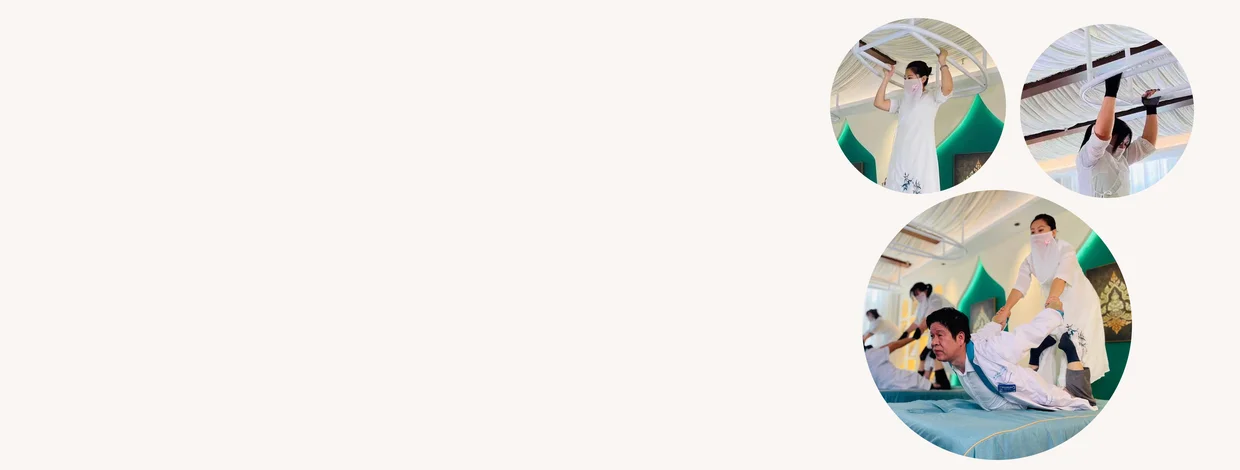
Thai spa massage
training in China
The SHEYI school programme in Zhengzhou: Thai massage and stretches, foot work on the four sides of the body, aromatherapy and twelve wellness spa treatments. Two weeks, with a teacher who has 20 years of experience.
Thai spa massage: technique, stretches and spa treatments
SHEYI school programme, Zhengzhou. Two weeks
Thai massage is about 2,500 years old: an Indian practice shaped by Ayurveda and traditional Chinese medicine. The school programme combines it with stretches, foot work on the four sides of the body, aromatherapy and twelve wellness spa treatments. The school's materials are translated into Russian.
What the training includes
Groups are enrolled regularly, dates on request
- Two weeks of training; the school programme has eight teaching days on a schedule
- Theory: TCM basics, meridians, muscles and bones, spa of the back, abdomen, legs and head
- Thai massage and stretches: feet, legs, arms, lower back, neck, head
- Foot work on the four sides of the body and pain protocols
- Aromatherapy: essential oils, carrier oils and hydrolats, formulations
- Twelve wellness spa treatments of the school
- Cultural block: singing bowls, meditation, tea ceremony, incense, calligraphy
- Programme materials in Russian
How to book a place
- Sign the contract (we send a link)
- Pay a deposit of 50 EUR / 25 000 tenge
- Send us your documents: passport, diplomas, certificates
- Receive the invitation invoice and pay the full amount or arrange instalments
- Buy the flight ticket
- Apply for the visa
Individuals pay to the settlement account of Academy 21 LLP or by bank card — in euro or tenge. For companies, on request: a commercial offer, a contract, an invitation invoice for payment and a certificate of completion.
SHEYI Vocational Training School, Zhengzhou
Training program
The concept of spa and the master's standards of conduct, meditative spa. Meridians: the concept, the twelve meridians, their distribution, connections and circulation order, the eight extraordinary meridians. Myology and osteology. Spa of the back: points, zones, diagnostics.
The gastrointestinal tract and abdominal spa, including contraindications. Spa of the legs: meridians, benefits and the order of the treatment. Spa of the head: points, meridians, massage and tendon stretching.
- History and origins of Thai massage
- Features and advantages of the technique
- Who Thai massage suits
- Effect on the body, the mind and health
- Development of the field and demand
- Feet, legs and side-lying stretches
- Arms and shoulder girdle
- Lower back, head and seated stretches
- Back work: knees on the legs, knees on the back, knees on the shoulders and neck, lifting the lower back
- Dozens of full-body stretch sequences
- History and features of the technique, distribution of load on the bones
- On the back: relaxation, feet, legs, shoulders, back points, arms, glutes, calves
- From four sides: the front of the legs, abdomen, arms, side work
- Pain protocols: lower back and shoulder joint; stretches for back, lower back, sciatic nerve, neck, head and hamstring pain
- The concept of aromatherapy and its place among other practices
- Three components: essential oils, carrier oils, hydrolats
- Methods of use: aroma lamp, inhalation, bath, application, massage
- Nine aroma types, properties of oils, five elements
- Formulations: basic knowledge, seven chakra oils, popular blends, blends for quality of life
- Aromatherapy spa: foot scrub, breast care, lymphatic drainage, kidney care, glute care
- Body shaping and meridian spa: bioenergy devices, vacuum cups, electrostimulation
- Spa of five senses and six sensations
- Spa on Himalayan salt stones
- Spa with hinoki — Japanese cedar
- Spa with hot shells
- Spa with herbal pouches
- Spa of five sounds: singing bowls, tingsha, rain stick
- Meditative spa: zen, mindfulness, body scan, sleep, yoga, space
- Thermotherapy with singing bowls
- Energy of the seven chakras
- Yao warming — moxa therapy
- Preparing the master and the order of the treatment
Bonus modules of the school: singing bowls, meditation, five sounds. Cultural block: six types of tea and the tea ceremony, Song dynasty tea powder, incense, calligraphy and sutra copying. Separately — moxa therapy, service psychology and salon organisation.
Practice: the couch and stretches
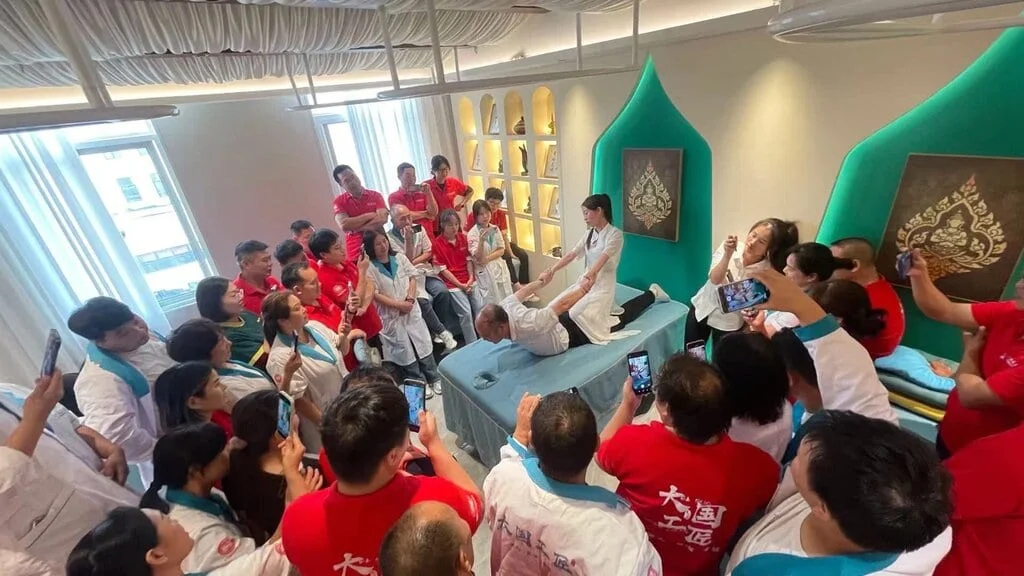
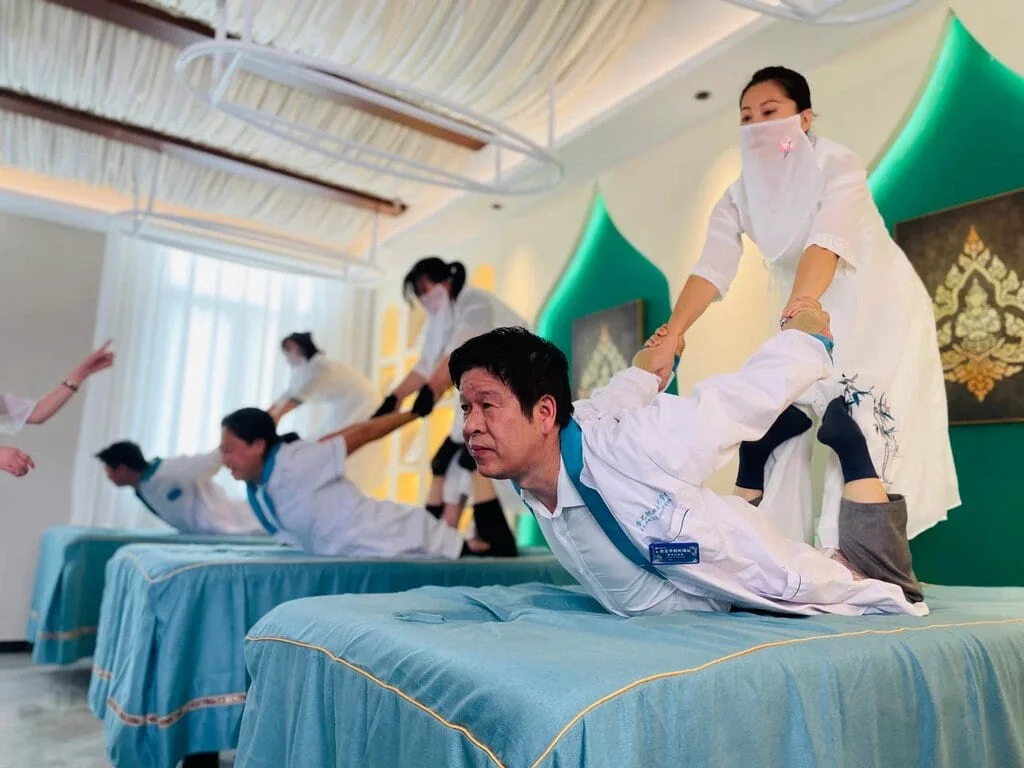
The core of the programme is couch work: stretches, Thai massage techniques and foot work. Classes cover the master's body position, the distribution of weight and the sequence of techniques.
The programme covers techniques for the feet, legs, arms, lower back, neck and head, plus full-body stretch sequences. Each technique is demonstrated on the couch and practised in pairs, swapping roles: the master works both as practitioner and as guest.
Thai massage technique demonstration
Demonstration clips: couch work and foot technique — the master stands on the guest and holds the upper support.
Culture and service
The programme includes the school's cultural block: tea ceremony, incense, calligraphy and meditation. It does not replace practice; it shows how the atmosphere of a spa salon is built.
A separate block covers service and organisation: guest reception standards, preparing the room and the order of a treatment.
Frequently asked questions
How long does the training take?
Two weeks; the school programme has eight teaching days on a schedule.
How much does the training cost?
€9,000 for the programme, with 24 monthly instalments of €375.
Where does the training take place?
At the SHEYI school in Zhengzhou, China.
What does the programme include?
TCM and anatomy theory, Thai massage and stretches, foot work on the four sides of the body, aromatherapy, twelve wellness spa treatments, the cultural block and materials in Russian.
Who teaches?
Wei Xiaoyan (魏晓燕), 20 years of experience in the field.
Places are limited
Book your place and fix the price now.